Since Stephen Colbert inspired us to think about the meaning of "truthiness", I wanted to be the first to introduce the word "fairlessness". You never know when a word like this may come in handy, but what does it mean? In order to be fairless, one must be fearless about being less than fair. In other words, if you would be fairless, you must blatantly call for, or enact, unfair laws, principles and polices in the name of fairness. Fairlessness abounds in our world, and when ever someone begins a sentence with "We all have to make sacifices..." or "In order to create a level playing field...", you know that you will soon be up to your knees in fairlessness. At least now you have a name for it.
Fairless, adj: describing the quality of being fearless about being less than fair.
Thursday, March 30, 2006


Monday, March 27, 2006
Is there a little Dowie in W?
President may be related to 19th century Evangelist

Look who's tending bar!
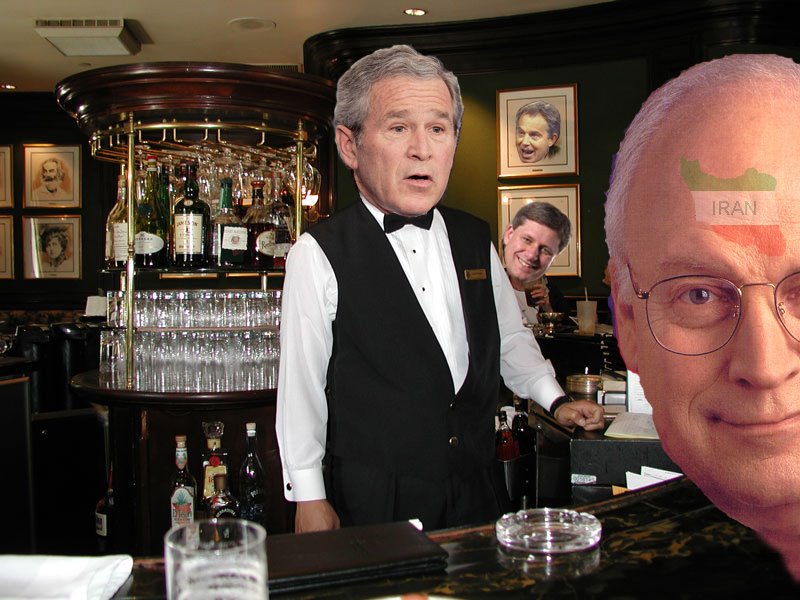 This "vision" came to me in a dream last night, so I decided I just had to oust the night demons by making this montage. You would have to open the full-size version to decode all of the faces, but here is the basic idea: Tony Blair has been mounted on the wall in a permanent grimace and stares at W, wondering what will happen next. My Prime Minister (Stephen Harper) grins sheepishly at his idol. Like a deer caught in the headlights, our big-headed barkeep stares at deadeye Dick. Guess what Dick is thinking about? God I hope I hope I hope I hope none of this is true.
Sunday evening anger
So Tony Blair is trying to convince himself that he did the right thing by toadying up to George Bush and committing British troops to Iraq and Afghanistan. As reported in CNN:
Don't get me wrong, I believe that any country that tries to run itself according to the laws of a medieval (or older) religion is a ridiculous enterprise that, when left to itself, will only lead to bloodshed and failure. But such countries should be permited to work out their problems without our "help". Unfortunately, when European and North American interests interfere, the misery of these failing states is usually prolonged. The only way to help is for the keepers of these "universal values" to stop selling arms and chemicals.
George and Tony: if you insist on spreading universal values, call it for what it is: an attempt to forcfully stamp Judeo-Christian-Capitalist values on every other culture on the planet. After all, the New York Times reports that Bush "was determined to invade Iraq without the second resolution, or even if international arms inspectors failed to find unconventional weapons" according to a confidential memo written by David Manning, Blair's top foreign policy adviser.
Will Iran be the next country to bend over to be freedomized by George and Tony?
"If we want to secure our way of life, there is no alternative but to fight for it," he told a joint sitting of the Australian parliament in Canberra on Monday.Well Tony, "our way of life" seems to be different all over the world. In Afghanistan, mainstream clerics and citizens want to execute a Muslim because he converted to Christianity. George is "troubled" by this. Condi calls President Karzai to explain the unacceptablilty of the situation. In that same country, village elders smiled and chatted with Canadian soldiers and then dispersed instantly (and knowingly?), when a young rebel ran out and slammed an axe into a Canadian soldier's head. And yet:
...in the struggle to defend global values, Blair said there was no prosperity without security, and no security without justice. He said a global alliance should be pushing to defend universal values wherever they were under threat.Here's the thing. There are no universal values of justice. We can't even enact and apply laws equally and justly within our own countries. Don't pretend that bringing democracy to Iraq or Afghanistan or any other country is an altruistic gift that has no political or economic -- or cultural -- strings attached. Don't pretend that you are not filled with blind arrogance and a firm belief that your values, laws, god and way of life are superior to those of the countries you invade.
Don't get me wrong, I believe that any country that tries to run itself according to the laws of a medieval (or older) religion is a ridiculous enterprise that, when left to itself, will only lead to bloodshed and failure. But such countries should be permited to work out their problems without our "help". Unfortunately, when European and North American interests interfere, the misery of these failing states is usually prolonged. The only way to help is for the keepers of these "universal values" to stop selling arms and chemicals.
George and Tony: if you insist on spreading universal values, call it for what it is: an attempt to forcfully stamp Judeo-Christian-Capitalist values on every other culture on the planet. After all, the New York Times reports that Bush "was determined to invade Iraq without the second resolution, or even if international arms inspectors failed to find unconventional weapons" according to a confidential memo written by David Manning, Blair's top foreign policy adviser.
Will Iran be the next country to bend over to be freedomized by George and Tony?
Saturday, March 25, 2006
A step closer to a cure for T1 Diabetes
 Three cheers to Denise Faustman, the innovative Diabetes researcher who has found a way to halt the autoimmune process that destroys pancreatic islet cells in Type I diabetics. So far, her work has focused on diabetic mice, but because her approach involves modulating the immune system, there is good chance it may also work in humans. She has succeeded in reversing diabetes in mice by injecting them with Freund's Complete Adjuvant (FCA), a mixture of water, oil and parts of dead bacteria. Apparently this compound stimulates T cells that attack the pancreas and causes those T cells to self-destruct. Faustman's research also involved transplanting spleen cells into the mice and she found that these cells differentiated into islet cells, allowing the treated mice to produce their own insulin. The big news this week is that three other labratories have now independently validated the first procedure -- the abatement of autoimmune islet destruction. While these labs did not confirm that spleen cells had any effect on producing new islet cells, they did discover that a significant number of tested mice regenerated their own islet cells after the destructive T cells were eliminated. In other words, by teaching the immune system to stop attacking islet cells, these researchers found that many diabetic mice were able to self-repair islet function and produce their own insulin.
This is absolutely fabulous news. A cure for diabetes would make millions of people happy and would free up billions of dollars that could be spent to tackle other diseases and global issues. It just might create an avalanche of good! With significant help from the Iacocca Foundation, Faustman is gearing up for human trials of this treatment. If you would like to help out, please donate a few dollars to help fund Faustman's work at the Massachusetts General Hospital Diabetes Unit.
It's important to realize that despite the promise shown in Faustman's work, her efforts have garnered no interest or money from large pharmaceutical companies or from the Juvenile Diabetes Research Foundation. Some have accused the JDRF of refusing funding due to a political bias that favours stem cell research. If that is the case, Faustman's work will rely even more on individual donations if it is to continue.
Tuesday, March 07, 2006
Have you Weboggled?
I’ve never been a big fan of computer games. Perhaps it’s because my brother and I were teenagers when the first TV “Pong” game came on the market. We had one, and for a few months we played against each other and against “the box” for hours every day. The games were limiting, but they did help us channel a bad case of sibbling rivalry into a safe, bruise-free virtual space. In any case, once you've experienced the monochromatic excitement of a 5-hour Pong marathon, modern 3D games with their billions of polygons and complex shaders just don't hold much interest. Or maybe it's just that I truly suck at 'em. In any case, the video game era has left me in the dust.
And then there was Weboggle.
It's a great web adaptation of Boggle. It's simple and elegantly done. It's fun and it's free. But the competition is fierce. You can take everyone on or you can play in teams. If you love words, you should PLAY THIS GAME.
 Pick a handle and attach it to a sharp pointy idea
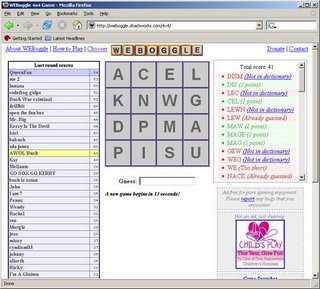
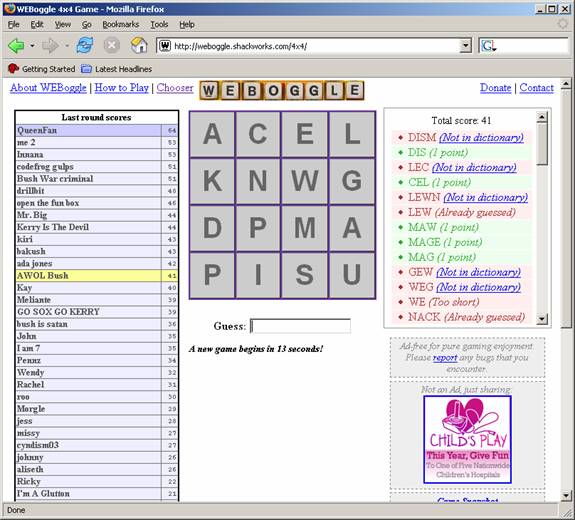
There is nothing deep about playing Weboggle, but a while back I was musing over the game handles players were choosing. The freedom to adopt any handle allows WebBoggle users to assert a kind of agency, to link themselves with a political movement, a trend, an emotion or just about anything. The screen on the left is fairly typical: players include “Bush War Devil”, “Kerry is Satan”, “AWOL Bush”, “Go SOX Go Kerry”, etc. Some players log in with web site addresses (hoping other users will visit their URLs). Others use self-disparaging (or aggrandizing) names. Nothing new here -- the web has always been about alter egos and virtual (risk free) grandstanding. For me the interesting aspect of using these handles is in linking the player’s message with their skill level. A pro-Bush player who wins consistently seems to mean more than a similar name that languishes in the bottom half of the score box. I don’t really believe this, but it “feels” like it is true. In Colbertian terms, there seems to be a quality of truthiness in Weboggle handles. I could add that it seems as if anti-Bush players seem land in the top five positions more frequently. But this could be my own subjective bias -- I am blinded by the truthiness. Perhaps all of this says something about the culture of winning that permeates our world and what it does done to our language. We compress complex sets of ideas into “platforms”, talking points, sound bites, slogans and even single words: flip-flop, AWOL, global test, etc. A picture is worth a thousand words, but a single word can be worth a million votes. Or so it would seem. On the other hand, looking for meaning in Weboggle scores is probably at least as silly the thought that exercising one’s “agency” by playing Weboggle could ever be a meaningful political act.
And then there was Weboggle.
It's a great web adaptation of Boggle. It's simple and elegantly done. It's fun and it's free. But the competition is fierce. You can take everyone on or you can play in teams. If you love words, you should PLAY THIS GAME.
 Pick a handle and attach it to a sharp pointy idea
There is nothing deep about playing Weboggle, but a while back I was musing over the game handles players were choosing. The freedom to adopt any handle allows WebBoggle users to assert a kind of agency, to link themselves with a political movement, a trend, an emotion or just about anything. The screen on the left is fairly typical: players include “Bush War Devil”, “Kerry is Satan”, “AWOL Bush”, “Go SOX Go Kerry”, etc. Some players log in with web site addresses (hoping other users will visit their URLs). Others use self-disparaging (or aggrandizing) names. Nothing new here -- the web has always been about alter egos and virtual (risk free) grandstanding. For me the interesting aspect of using these handles is in linking the player’s message with their skill level. A pro-Bush player who wins consistently seems to mean more than a similar name that languishes in the bottom half of the score box. I don’t really believe this, but it “feels” like it is true. In Colbertian terms, there seems to be a quality of truthiness in Weboggle handles. I could add that it seems as if anti-Bush players seem land in the top five positions more frequently. But this could be my own subjective bias -- I am blinded by the truthiness. Perhaps all of this says something about the culture of winning that permeates our world and what it does done to our language. We compress complex sets of ideas into “platforms”, talking points, sound bites, slogans and even single words: flip-flop, AWOL, global test, etc. A picture is worth a thousand words, but a single word can be worth a million votes. Or so it would seem. On the other hand, looking for meaning in Weboggle scores is probably at least as silly the thought that exercising one’s “agency” by playing Weboggle could ever be a meaningful political act.
Monday, March 06, 2006
I needed a small (Canadian) chuckle so...
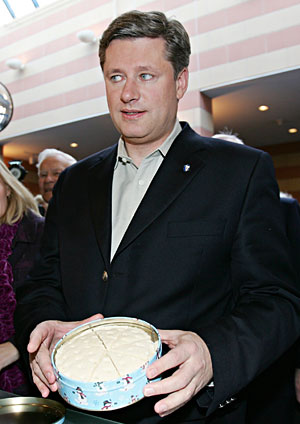 Ok, it's a very small chuckle. Rick Mercer of The Mercer Report fame recently challenged anyone with too much time on their hands to create an image that takes Canada's Prime Minister out of one strange context and insert him in another.
On the left we have the original: Prime Minister Harper poses in Zombie-like fashion with what appears to be either a tin of Plutonium or a lovely cheesecake. It wanted a bit of symbolism, so I placed Harper, a staunch westerner, on a rusty tractor so he could take David Emmerson's head to market. Not to be confused with Ralph Waldo, this Emmerson is a former Liberal M.P. who crossed the floor to join Harper's cabinet about 25 seconds after being re-elected. In Canada, some politicians are bought and sold like bushels of wheat. U.S. congress members are a little more expensive, I'm told. This is old news, of course, but it can be legitimately be repeated over and over out of respect for Emerson's constuents who were kicked in their political pearly whites by his defection.
 If I was really trying to be fair (ha!), I would have completed the picture by placing Belinda Stronach in front of the tractor. Harper would be unlikely to brake for a Convervative member who defected to the Liberals and quite a few boomer Tories living in Newmarket, Ontario would be cheering him on.
On the otherhand, at least Belinda had the grace to defect before any votes were actually cast -- and she was still elected.
Wednesday, March 01, 2006
Spring! Sproing! Sprung!
 Another gawdawful February has finally run its course -- though this Feb was more like a typical southern Ontario Jan and Jan was more like a Mar or an Apr. Clearly someone is mixing up the months. Could it be us? In any case, if you live in a northern climate then I hope this Chestnut-sided warbler gives you some hope for the coming spring. Two years ago I was lucky enough to spend some time around Pt Pelee, Ontario during spring migration. On the day this was taken, two large groups of birders were standing on either side of me, straining to see a fairly rare Golden Wing warbler. They couldn't understand what I was looking at because I was very close to the Golden Wing and not looking at it. My view of that bird was blocked, but this little guy decided to pose on a branch just a few feet from from me. Bayootifool plumage, wot? Just goes to prove again that the most beautiful things imaginable are often closer to us than we think and that learning how to see is as difficult as it is important. I keep relearning this lesson every time we tramp around the edges of forests, wetlands and lakes looking for birds. Annie Dillard points out in her essay, Seeing: "My eyes account for less than one percent of the weight of my head; I'm bony and dense; I see what I expect". Bony and dense. She can say that again.
Tuesday, February 28, 2006
The Incredible Grippy Truthiness of Stephen Colbert
 Have you all been watching The Colbert Report? At first I had mixed feelings when Stephen Colbert left the Daily Show to become the proprietor of his own show. He was one of the main reasons I watched the DS in the first place. I still miss his "This Week in God" segments, though Rob Cordrey's version of same is wonderful in its own way. But the older bits like the "Even Stev/phen" segment that featured Colbert and Steve Carell were consistently brilliant and hilarious.
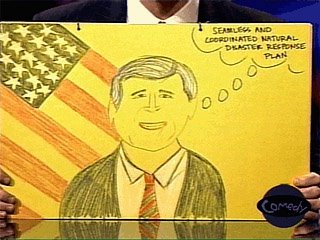 But all good things must be cancelled or spun off or moved to a new timeslot, right? The Colbert Report is fast becoming a great show in its own right, though the cult of St. Stephen can be overwhelming at times. But, if you have seen the show, you have to admit that the writing is spectacular and Colbert's delivery is usually spot on.
Tonight's Word was "Trial Separation" -- a riff on the idea that the separation of church and state is gradually being eroded in the U.S. After all, "In god We Trust" is written on U.S. money "right where Jesus would want it to be", he tells us. It's an old, but still apt observation. But this is The Comedy Network, right? So, instead of picking too deeply at our various spiritual wounds, Colbert pushes the discourse into the realm of the absurd with a 2-minute comparison of major religious end-of-the-world stories. And these are compared with a Toyota Camry of all things! Playing on the consumer notion that anything can be bought and sold, Colbert suggests we comparison shop for an end of the world story that provides value and comfort -- and, if possible, the safety afforded by side-impact air bags. It made me laugh but I can't decide whether it was as funny and smart as it seemed or whether it was just an excuse for a product placement. Or both.
 Which brings me to the real enigma that is Stephen Colbert: unlike John Stewart, he almost never shows his political cards. Maybe good satire always needs an element of suspense, a way of keeping the audience on edge as they try to guess what the satirist really thinks. If that is true, then Colbert is the Alfred Hitchcock of TV satire.
Monday, February 20, 2006
Book Review: The Red Power Murders by Thomas King

The new novel depicts the complex convergence of past and present enemies and friends in the small town of
Harper-Collins Publishers Limited
Release Date: March 2006
Sunday, February 19, 2006
PenOpticon... Panopticon... PunOpticon
 It has been several weeks and at least one quail hunting accident since I began this blog and you have all been most courteous by leaving me to my lonesome self. That's ok. After all, of all the packets being flung out of a hundred million web servers, and of all the bumph, blurbs and blogs you have to choose from, how could you possibly have ended up here? Like thousands of other hapless bloggers, I'm just typing away in a vacuum -- a digital bell jar -- hoping to break through the glass.
Anyhow, since you have stumbled upon something called the PenOpticon, there should be at least one entry explaining the rationale for the name. It was in fact inspired by Jeremy Bentham's 18th century Panopticon, a design for a perfect prison. But, the only reason I knew about Bentham was from a shallow exposure to Michel Foucault's discussion of the panopticon as a metaphor for all sorts of state and institutional power relations.
And so I wondered, to what degree does language operate as a panoptic structure. Are there ways in which the habits of convention and cliché imprison the writer in his/her own language? In another sense, I am locked in this blog, typing my brains out, knowing that anyone could read these words, but never really knowing if anyone does (assuming no one will comment!). The best I can do is try to write as if you really are out there -- much like Offred in Margaret Atwood's The Handmaid's Tale: "I write, therefore you are".
So here is the obvious conceit: just as Bentham's Panopticon was an "all-seeing eye", I suppose I intended to turn this PenOpticon into an all-seeing pen. Aside from the pun there is a more serious joke: the realization that the pen - the blogger - is truly constrained and imprisoned by the very institution of writing/language in general and digital writing in particular. So the PenOpticon is not a persona, but something to transcend. The goal is to break free of language and conventions that make communication difficult, to shatter the glass of this digital vacuum. And finally, just to mangle the metaphor a little more: as long as the vacuum remains intact, at least some of these posts are bound to suck.
Tuesday, February 14, 2006
Scraping off the topsoil
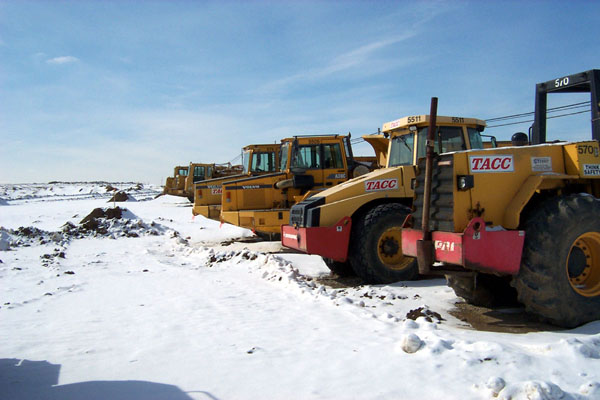 I happen to live a few kilometres north of Toronto in a town that has grown from 12,000 to 160,000 people since I moved here in 1972. It is astounding to think how much we have been able to alter the landscape in such a short span. In the late 70's people in these parts tried but failed to stop the opening of the Keele Valley Landfill-- a facility that "grew up" to become a 28-million ton mountain of waste. Now that the site has been capped with clay, it is being turned into "passive recreational land", replete with soccer fields and an 18-hole golf course. As thousands of new home owners pour in, I wonder if they are aware of the environmental history of the area. A huge swath of houses is slated to be built just south of the former dump site. Last winter I took a few pictures of the heavy machinery that has now scraped off millions of tons of top soil, sand and clay from what used to be fields of corn and woodlots. What took glaciers thousands of years to create has been undone in a matter of months. And some people doubt that humans could be causing global climate change?
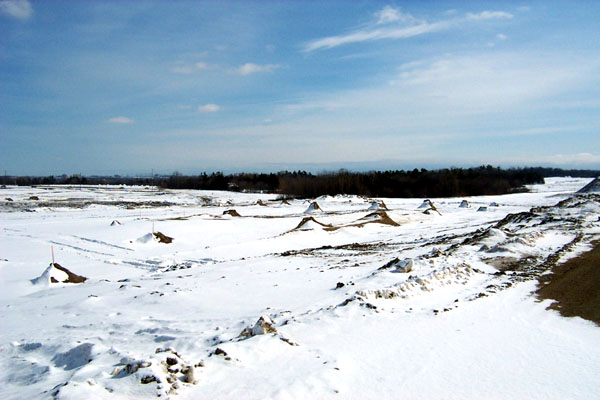 So what are the real costs of this development? Over the past 35 years, the air quality has gotten steadily worse as the Greater Toronto Area became a snarling mess of vehicles huffing poison. We are told that rates of asthma and resperatory diseases have increased dramatically in recent decades. Last summer a single rainstorm caused unprecedented road damage and flooding because the GTA is so built up there is no where for run-off water to go. A week ago, another sinkhole opened up, swallowing a major intersection. Meanwhile, York Region continues to build the BIG PIPE, a sewage project that has involved pumping out billions of litres of ground water from the Oak Ridges Morraine aquifer. If completed, this pipe will encourage even more sprawl, accelerating the region's ecological death spiral.
 It is sad and appalling to watch politicians and developers work together to commit teracide in the name of free enterprise. Future generations (should they survive) will look back upon this age of "development" with bemusement. This meandering scribble is not a protest -- I am just as guilty for watching all of this take place and have not put up much of a real fight. It is amazing how we gaze with upon ancient pyramids and tombs and wonder how the ancients could build such massive structures. It is easy to forget that every day we create our own giant pyramids of waste spread out over entire countries, scrape millions of acres bare of vegetation and soil in order to choke our own planet. Perhaps only a 50-year, time-lapse movie, shot from space could show these activities for what they appear to be: a form of cancer, or madness, or both.
Tuesday, February 07, 2006
GeoCamming and Surveillance
 I think I am over the GeoCamming addiction -- finally. I haven't had the opportunity to travel outside of Canada much for the past few years, so cruising round the world, playing with security cameras has been a whole lotta fun. Please feel free to check out my slideshow tour of images from Australia, Japan and Portland, Oregon. I may have also made a stop in Hong Kong or Singapore. Part of the fun of GeoCamming is trying to find out exactly where you are! I watched a small Japanese town wake up, saw the sun light up the snow on Mt Fuji. I saw women hanging out laundry on the roof of a high rise in a far eastern city and workers smoking while waiting for a truck to arive at some anonymous loading dock. I saw couples holding hands next to a Razorback submarine in Portland and a people lounging on yachts in Queensland. I watched egrets wading in Japan and dogs playing on a beach in Hawaii. If you don't get out much, Geocamming can be a fun way to travel.
 It all started when I stumbled upon one of the first articles on GeoCamming at Hack a Day. There you can learn how to search for insecure web cameras using Google and other search engines. The cameras feature web-based interfaces that should be password protected -- but many are not. And many of these are high-quality cameras that allow you to pan, tilt and zoom around the neighborhood. Webcamplaza.net provides sample searches for some of the more common cameras on the web. The best cameras I have found were Sony SNC-RZ230N's models. Try searching Google for "inurl:home/homeJ.html" and you'll find quite a few of these. This view of Hawaii was spectacular!
GeoCamming raises many questions of privacy, safety and security. My slideshow includes a number of pictures of people -- and the quality is good enough that you could probably identify them if you knew any of them. There is nothing to stop anyone with a high-speed connection and a $500 camera from spying on his/her neighbors. In fact, some of these open cameras are probably just as useful to criminals as they are to the police. The ubiquity of surveillance is causing some to "fight back" using "Sousveillance" techniques. By wearing their own camera gear these groups actively watch the watchers in an attempt to even the playing field. For now, one could argue that the legions of open, insecure, controllable cameras available on the web give you and me a chance to get out from under the gaze of the big eye in the sky by taking control of the lens our selves. And yet we are still under the constant panoptic stare of countless routers, web and email servers, proxies, caches and cookie trackers. Almost every click is logged, data-warehoused and ultimately data-mined. So happy GeoCamming, watch and be watched, but don't let them catch your "I".
Monday, February 06, 2006
Focus... Folk Us... Fo Kiss.... Faux Cuss.... Fo Cause...
 Focus! That will be a huge challenge for me in this Blog. In the beginning all one can do is cast bread upon the waters to see what kind of interesting (and odd) ducks are swimming around out there. In this place the bread may consist of guitar, diabetes, health care reform, sensible weight loss, web design, computer culture, surveillance and privacy, reading, writing and wordplay, TV satire, hiking and birding, and a smattering of photography. I hope you'll stop by now and again!
Subscribe to:
Posts (Atom)